
Case Study
3D Scanning and Reverse Engineering a Car Side Mirror Mounting Bracket
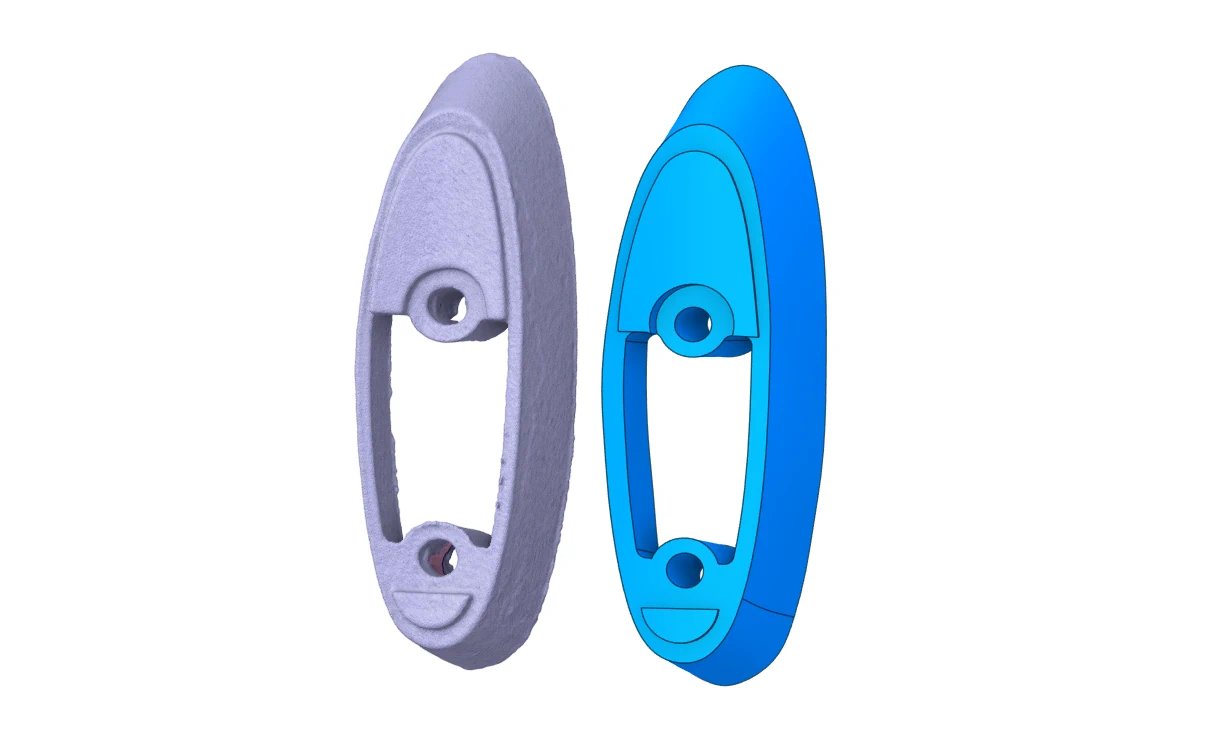
Project Overview: Creating an accurate 3D CAD model of an automotive part.
Services Provided: High-precision laser 3D scanning and computer-aided design (CAD) modelling.
Project Outcome: Delivering the client with a clean, editable 3D CAD model suitable for use in 3D printing and manufacturing.
Why OML3D: Our advanced 3D scanning equipment and reverse engineering expertise enabled us to achieve the accuracy and detail required for the project.
Restoring a Damaged Automotive Part with 3D Scanning in Sydney, NSW
Finding replacement parts for older, imported or discontinued vehicles can be difficult. Even parts that appear simple often contain complex geometry that makes them challenging to reproduce accurately.
Recently, we worked with a client who needed a replacement car side mirror mounting bracket. The original bracket had cracked around one of the internal mounting screw holes, with a small section of material missing from the inside of the part. Over the years, the bracket had also accumulated multiple layers of paint, leaving some areas of the surface rough and uneven.
There were no CAD files or engineering drawings available, so the damaged bracket became the starting point for the entire project.
Using high-resolution laser 3D scanning and reverse engineering, we recreated the missing geometry, produced a fully editable CAD model and printed a prototype for the client before supplying the final manufacturing files.
The Project
The client supplied the damaged mounting bracket with the goal of producing an accurate replacement.
Although the bracket looked fairly simple at first glance, it contained complex curved geometry across almost every surface. The top face featured a shallow concave profile, while the underside and side faces blended together through multiple compound curves. These surfaces allowed the bracket to sit correctly against both the vehicle body and the mirror assembly.
The damage itself was relatively minor but located in an important area around one of the internal mounting screw holes. Combined with years of paint build-up, the original shape of the bracket was not immediately obvious, making reverse engineering more involved than simply copying the scanned data.
Step 1: Inspecting the Original Part
The first step was to inspect the bracket and determine the most suitable scanning method. Because of the freeform geometry and the level of detail required, high-resolution laser 3D scanning was selected. The bracket was also covered with several layers of old paint, which had built up over time and created a rough surface in some areas. While the laser scanner accurately captured the existing shape of the part, the reverse engineering process focused on recreating the original component rather than reproducing imperfections caused by paint build-up, wear and damage.
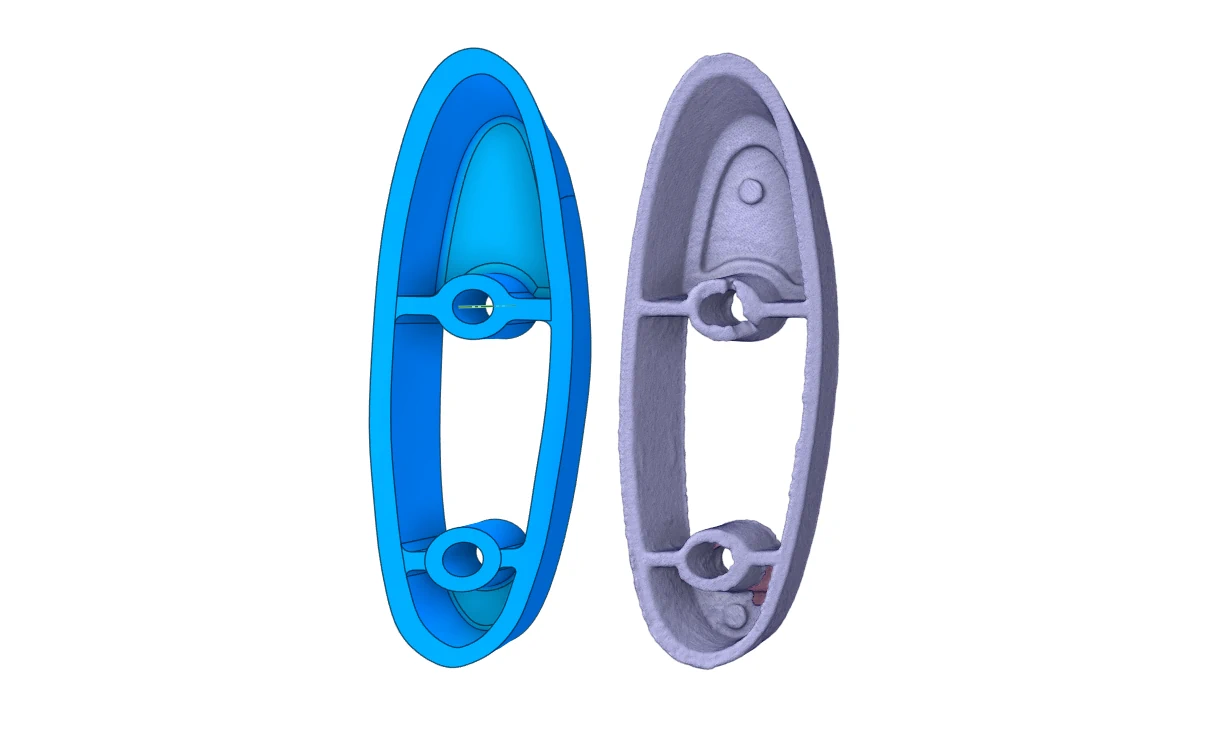
Step 2: Laser 3D Scanning
The bracket was scanned using our professional laser 3D scanning system. Multiple scans were captured from different angles to record every accessible surface. The individual scans were then aligned and merged into a detailed 3D mesh representing the complete geometry of the bracket. The scan accurately captured the mounting faces, curved surfaces and overall form of the component, providing an excellent foundation for reverse engineering.
Step 3: Reverse Engineering the Bracket
Once the scan data had been processed, the bracket was reverse engineered into a fully editable CAD model. The missing material around the internal mounting screw hole was reconstructed using the surrounding geometry, while the curved top, bottom and side surfaces were rebuilt using engineering-grade surface modelling. Surface irregularities caused by old paint were removed during this stage so the finished model reflected the original design rather than years of accumulated coatings. The result was a clean, accurate CAD model suitable for manufacturing. Because the model is fully editable, future changes can be made without repeating the scanning process. Dimensions can be adjusted, mounting features modified or design improvements incorporated if required. This also provides the client with a permanent digital record that can be used whenever additional parts need to be produced.
Step 4: Prototype 3D Printing
Before finalizing the project, a prototype bracket was produced using professional resin 3D printing. Printing a sample allowed the client to verify the fit and geometry before committing to production. If any adjustments had been required, they could have been made directly to the editable CAD model before manufacturing. Once the prototype had been approved, the editable CAD files were supplied to the client for future production.
A Practical Solution for Rare and Hard-to-Find Parts
Many automotive parts become difficult or impossible to source as vehicles get older. Manufacturers discontinue components, aftermarket replacements become unavailable, and second-hand parts are often worn, damaged or incomplete.
3D scanning and reverse engineering provide a practical way to reproduce these parts without needing the original design files.
Even when a component has cracks, missing sections or surface wear, it is often possible to reconstruct the original geometry and create a manufacturing-ready CAD model. Having an editable CAD model also means the design can be refined in the future. Weak areas can be strengthened, dimensions adjusted to suit different applications or improvements incorporated before new parts are manufactured.
For collectors, restoration workshops, performance workshops and owners of rare vehicles, this can mean the difference between repairing a vehicle and having it remain off the road because a replacement part is no longer available.
Professional 3D Scanning and Reverse Engineering Services in Sydney
Based in Sydney, NSW, we provide professional services for manufacturers, engineering companies, councils, utilities, and industrial businesses throughout Australia.
Our services include:
- Laser 3D scanning
- Structured Light Scanning (SLS)
- Reverse engineering
- 2D and 3D CAD Design
- 3D printing
- Inspection and measurement
- Fiber Laser Engraving
Need a Discontinued Vehicle Part Recreated?
If you have a rare car, boat, or vehicle part that’s damaged, missing, or no longer available, we can help.
Contact our Sydney team to discuss your project.
We provide professional laser 3D scanning, reverse engineering, and 3D printing services for automotive, marine, and vehicle restoration projects across Australia.
Contact Us